

14 Sep Why Humidity Matters More Than Most Lash Artists Realize
When I first started working seriously with lash adhesives, one of the things that became obvious very quickly was that the same adhesive could behave completely differently from one day to the next.
The bottle hadn’t changed.
My technique hadn’t suddenly changed.
The client hadn’t necessarily changed.
But the room had.
And more often than not, the difference was humidity.
For years, lash artists were taught to think about adhesive almost as though it were a fixed product: choose a glue, learn its drying speed, and use it.
But cyanoacrylate adhesive doesn’t work in isolation. It reacts to the environment around it, and humidity plays a major role in how quickly that reaction happens.
Understanding that changed the way I worked with adhesive — and eventually changed the way I thought about developing and categorizing adhesives for professional artists.
Lash Adhesive Is Not Working Alone
Most professional lash-extension adhesives are based on cyanoacrylate.
Cyanoacrylate begins polymerizing in the presence of moisture. In a lash room, some of that moisture comes from the humidity in the surrounding air.
That means the conditions in your salon are actively influencing your adhesive while you’re working.
When humidity changes, the behavior of the adhesive changes too.
This is why an adhesive that feels perfect in one salon may seem completely different in another.
It is also why the same artist can have beautiful retention one week and suddenly struggle the next if environmental conditions have shifted.
What Happens When Humidity Is Higher?
Generally, more moisture in the air causes cyanoacrylate adhesive to begin setting more quickly.
For a very fast artist, that can sometimes be helpful.
But faster is not automatically better.
If the adhesive begins setting before you have achieved proper contact with the natural lash, the bond may not form the way you intended.
The extension may appear attached, but the actual contact area can be compromised.
This is one of the reasons I have never believed that simply advertising an adhesive as “faster” necessarily makes it a better adhesive.
The goal isn’t to see how quickly glue can harden.
The goal is to give the lash artist enough working time to create a strong, clean attachment before the adhesive begins setting.
What Happens When Humidity Is Lower?
In a dry environment, the opposite problem can occur.
Polymerization may happen more slowly.
An adhesive that normally grabs quickly can suddenly feel sluggish.
Extensions may move after placement.
Fans may close.
The artist may begin using more adhesive in an attempt to compensate.
And that can create another set of retention problems.
This is why simply blaming the adhesive when something changes can send an artist down the wrong path.
Sometimes the first thing worth checking is not the bottle.
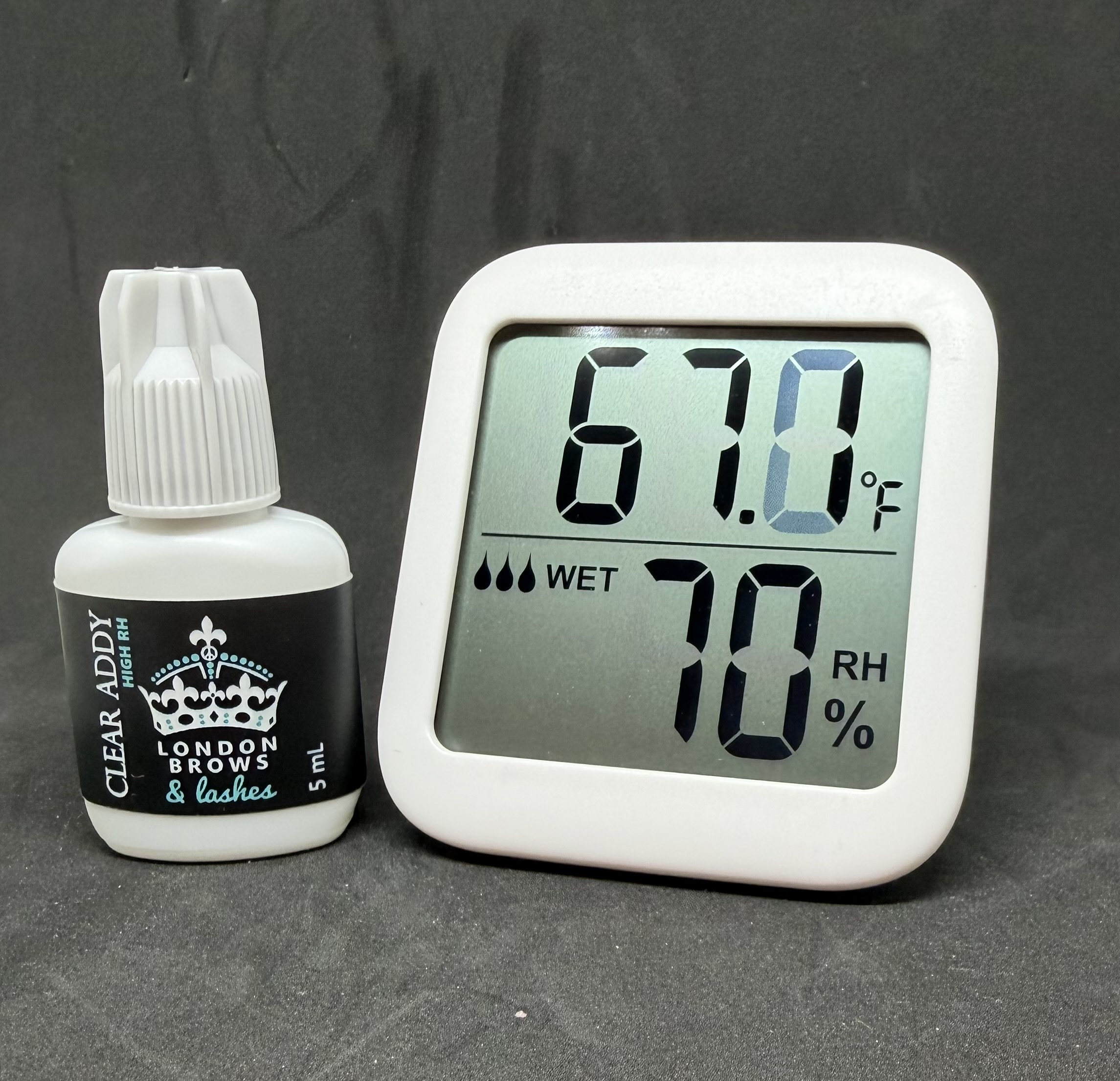
It’s the hygrometer.
Why I Started Paying So Much Attention to the Lash Room
As I worked with adhesives more and more, I began paying much closer attention to the conditions in the room.
Temperature mattered.
Humidity mattered.
The age of the adhesive drop mattered.
Even how frequently the adhesive was refreshed mattered.
I eventually began thinking about adhesives not simply as “fast” or “slow,” but in terms of the environment in which the artist was actually working.
n my own product development, that led me to separate adhesives according to humidity conditions rather than pretending one formulation would behave exactly the same in every salon.
It was a very practical decision.
A lash artist working in a dry environment may need something different from an artist working in a humid environment.
That sounds obvious today.
At the time, it wasn’t something I saw being discussed nearly enough.
This Is Why Every Lash Artist Should Own a Hygrometer
If you are working professionally with lash adhesive and you don’t know the humidity in your room, you are missing an important piece of information.
A small hygrometer can tell you:
- the relative humidity in your lash room
- the temperature
- whether your environment has changed significantly since your previous appointment
That information gives you context.
If your adhesive suddenly feels faster than usual, look at the humidity.
If it suddenly seems slower, look at the humidity.
If retention has changed unexpectedly across several clients, look at the environment before deciding the adhesive itself has suddenly failed.
A hygrometer doesn’t solve every retention problem.
But it removes an enormous amount of guesswork.
Manufacturer Ranges Matter — But So Does Real-World Observation
Every adhesive should have a recommended operating range provided by the manufacturer.
Those ranges matter.
But I also think working artists need to pay attention to what they are actually seeing at the treatment table.
Two artists can use the same adhesive differently.
One may isolate and place exceptionally quickly.
Another may take a little longer to perfect the attachment.
Their ideal working conditions may therefore not feel identical even when the adhesive is technically operating within its stated range.
That is why learning your adhesive is just as important as reading the specifications on the bottle.
Watch the behavior.
Watch the attachment.
Watch your retention.
And record your room conditions.
Over time, patterns become very obvious.
Humidity Is Only One Part of Retention
I also want to be careful about something that gets oversimplified in lash education.
Humidity is important, but it is not the explanation for every retention problem.
Retention can also be affected by:
- lash preparation
- attachment area
- adhesive amount
- placement technique
-
- room temperature
- adhesive freshness
- storage
- client skincare
- medications and physiological factors
- aftercare
- natural lash shedding
A good lash artist learns to troubleshoot systematically rather than blaming one variable.
But environmental conditions are one of the easiest variables to measure — and one of the most frequently overlooked.
Faster Isn’t Always Better
This is especially relevant now that adhesives are increasingly marketed by extremely short “dry times.”
You’ll see claims such as one second, half a second, and sometimes even faster.
But artists should understand what those numbers actually mean.
A claimed setting speed doesn’t mean you have half a second to dip an extension, move to the client’s eye, isolate a lash, position it and perfect the attachment.
The important question is how the adhesive behaves once it contacts the natural lash under the stated environmental conditions.
And those environmental conditions matter enormously.
A very fast adhesive in high humidity can become unforgiving.
If it begins setting before you’ve created the attachment you want, speed becomes a disadvantage rather than a benefit.
This is a subject I plan to explore in more detail in another article, because the way adhesive “dry time” is marketed deserves a conversation of its own.
Know Your Room Before You Blame Your Glue
If there is one habit I would encourage every lash artist to develop, it is this:
Know your environment.
Don’t guess the humidity.
Don’t assume today’s room is behaving like yesterday’s room.
Check it.
And when retention changes, write down what was happening in the room along with everything else.
The more you understand the relationship between your adhesive and your environment, the less mysterious retention becomes.
For me, learning to look beyond the bottle was one of the biggest changes in the way I approached lash adhesive.
Because an adhesive doesn’t work alone.
It works in the room you’re standing in.
Sorry, the comment form is closed at this time.