

03 Sep History of Clear Lash Adhesive | How One Retention Client Changed Everything
The History of Clear Lash Adhesive: The Discovery That Changed the Way I Looked at Retention
When I entered the lash industry, black cyanoacrylate adhesive was simply what lash artists used. It was familiar, it was readily available, and very little attention was being paid to the possibility that the pigment itself might matter. This is my history of clear lash adhesive.
My own path to clear adhesive did not begin with lashes at all.
It began with brow extensions.
In the early years of my career, I was working with brow extensions at a time when the service was virtually unknown in the United States. As far as I was aware from the industry around me at the time, I was the first person in the U.S. offering brow extensions professionally.
Brow extensions presented a problem that ordinary black lash adhesive could not solve very elegantly: black adhesive was visible.
I wanted an adhesive that would disappear rather than leave a dark attachment point.
So I approached chemical engineers with what seemed like a simple question:
Could we take the cyanoacrylate adhesive being used for lash extensions and formulate it without the carbon black pigment?
That question eventually led me to a clear adhesive.

At first, the reason for wanting it was purely aesthetic. I needed something transparent for brow-extension work and for applications where black adhesive simply did not make sense.
I had no idea that it was about to teach me something much more interesting.
The Client Who Changed Everything
I had a lash client whose retention was the worst I had ever encountered.
No matter what I did, she shed extensions at an extraordinary rate. She would virtually lose an entire set within a week.
Anyone who has worked professionally with lash extensions knows how frustrating a client like this can be. You start questioning everything.
Was it preparation?
Was it humidity?
Was it the amount of adhesive?
Was it the client’s natural lash cycle?
Was there something in her skincare?
Was it something I was doing?
Then one day I decided to give her a set of colored lashes.
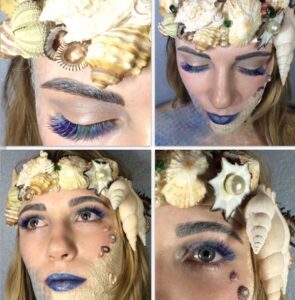
Because I didn’t want black adhesive interfering with the colored extensions, I used the clear adhesive.
And then something very strange happened.
She didn’t come back.
A week passed.
Then another.
By the third week, I actually texted her and asked why I hadn’t seen her.
Her answer stopped me in my tracks.
She told me she hadn’t needed to come back because almost all of her lashes were still there.
This was the same woman who had been losing virtually an entire set every week.
The major thing I had changed was the adhesive.
And that was my aha moment.
What Was Different?
The obvious difference between the adhesives was that one contained carbon black pigment and the other did not.
That did not automatically prove that carbon black was responsible for her previous retention problems. One client experience cannot establish that scientifically, and adhesive performance is affected by many variables.
But as a working lash artist, the difference was impossible for me to ignore.
It changed the questions I began asking.
Why had this client responded so differently?
Was the clear formulation behaving differently?
Could certain clients perform better with a pigment-free adhesive?
Could something we considered merely a cosmetic ingredient actually matter to the way an adhesive performed for some people?
Those questions became much more important to me than the original reason I had created a clear adhesive.
I had started out simply trying to make an adhesive that wouldn’t show in brow extensions.
Instead, I had stumbled into a completely different conversation about lash retention.
Clear Adhesive Wasn’t Just About Color Anymore
Clear adhesive subsequently became useful for several obvious reasons.
It was ideal for colored lashes because there was no black attachment point competing with the color.
It was useful when an artist wanted an invisible bond.
And, of course, it became particularly interesting for clients for whom a traditional black adhesive simply didn’t seem to perform well.
But my interest in clear adhesive has always gone back to that first client.
I remember waiting for her to return after a week.
Then two weeks.
Then finally contacting her myself.
I wasn’t trying to prove a theory.
I didn’t even have a theory yet.
I was simply trying to understand why a client who could barely retain lashes for seven days was suddenly telling me, three weeks later, that most of them were still attached.
That experience changed the way I thought about adhesive formulation.
Why This History Matters Today
The lash industry is very different now.
Clear adhesives are widely available, and it would be easy for a newer lash artist to assume that they have simply always been another standard product choice.
They weren’t.
Like many innovations in the beauty industry, some of the earliest developments came from working artists encountering a problem at the treatment table and asking:
Why does it have to be done this way?
That was exactly what happened to me.
Brow extensions created the need for an invisible adhesive.
A chemical formulation gave me the clear adhesive I was looking for.
And an extraordinarily difficult retention client made me realize that what I had created might be useful for reasons I hadn’t anticipated at all.
Sometimes innovation begins with years of research.
And sometimes it begins with a client who simply doesn’t come back when you expect her to.
A Note About This History
This article recounts my own experience working in the professional lash and brow industry and my recollection of the development process I was personally involved in. As I continue documenting this period in the industry’s history, I intend to distinguish between my firsthand experience and claims that can be independently verified through dated records and archival material.
Sorry, the comment form is closed at this time.